
Client
Aurelia Studios’ original piece
Year
2019
Our role
Sound design, production management
Listen
The approach
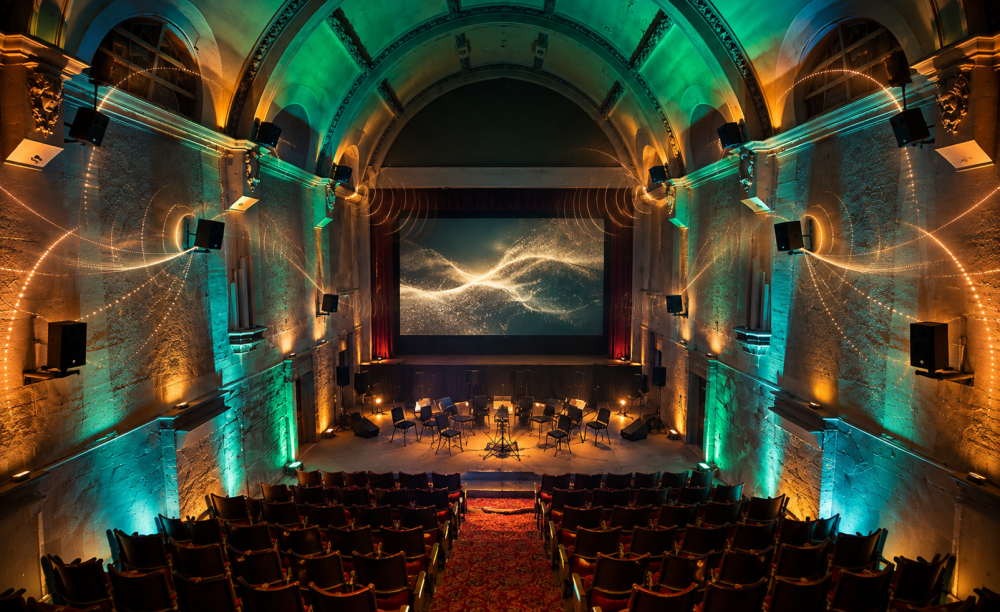
Aurelia Studios transformed the historic Paignton Picture House into an immersive, interactive sound installation, reimagining the cinema’s original 21-piece orchestra through spatial audio technology and audience participation.
Opened in 1914, Paignton Picture House is believed to be Europe’s oldest surviving purpose-built cinema. In its earliest days, film screenings were accompanied by a live 21-piece orchestra, with each musician paid a guinea to perform.
Drawing on archival material from the Paignton Picture House Trust and memories from the local community, Aurelia created Electric Sound Palace, a site-specific audio experience that connected the cinema’s rich musical heritage with contemporary immersive sound design.
In the very space once occupied by the original orchestra, Aurelia installed 21 individual loudspeakers, each representing a different orchestral instrument. Recordings of the Torbay Symphony Orchestra performing works by Beethoven and Shostakovich brought the ensemble back to life, creating an immersive musical experience rooted in the building’s history.
Working in collaboration with The Media Workshop, Aurelia took the installation one step further, transforming the orchestra into something audiences could actively play. Discreet Arduino-controlled switches, integrated into the hinges of the cinema’s century-old seats, allowed visitors to influence the music through their movements.
The result was an unpredictable, playful experience that challenged the traditionally passive relationship between cinema and audience. As visitors discovered their influence over the orchestra, the installation became as much a social experiment as a musical performance.
Electric Sound Palace brought together heritage, technology and immersive audio to give new life to a remarkable historic space, inviting audiences not simply to listen to its history, but to become part of it.
Credits
Concept & Experience Design – Chris Timpson & Carmen Talbot
Sound Design & Engineering – Chris Timpson (Aurelia)
Archive Research – Carmen Talbot
Interactive Technology – Tim Dolimore (The Media Workshop)
Orchestra Recording Engineers – James Stewart & Tommy Williams
Lighting Design – Dom Jeffrey
Technician & Operator – Alex Phillips
Additional Sound Editing – John Hendicott (Aurelia)
Oral History Recording – Carmen Talbot
Music performed by the Torbay Symphony Orchestra:
The Egmont Overture by Ludwig van Beethoven
Symphony No. 5 in D minor by Dmitri Shostakovich
Interactive Orchestra Music – Butterflies by Kevin Kerrigan (KK)